
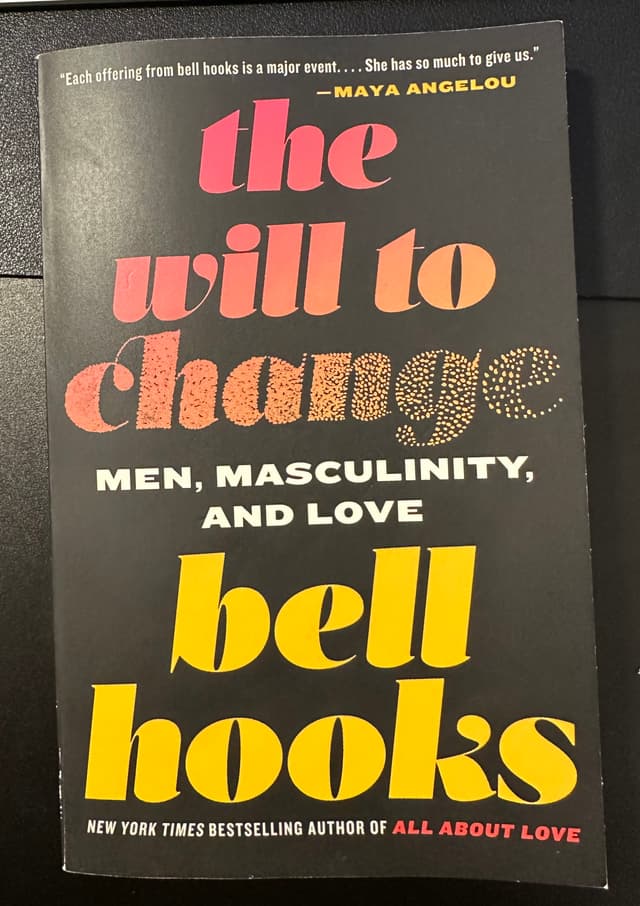
the will to Change: Men, Masculinity and Love Review
*DISCLAIMER/TRIGGER WARNING*
In this blog I'll be talking about some pretty heavy stuff including but not limited to SA, r*pe, violating consent, physical & emotional abuse, among other things. If any of these things are triggering for you to read about, I suggest not continuing. Additionally, I want to explicitly say that under any oppressive system, those deemed to be the main oppressor should not be the ones centered in the effort to overthrow said system. That being said, this blog and the book alike will hopefully provide some nuance regarding how patriarchal Black men can begin to recognize the pain brought unto us by the system and consider ways that we can reject it in our day-to-day lives.
Intro
As I write this blog, the Black community continues to find itself in quite the predicament that predates my birth year and may even out-age me. One side of the community says that "Men are trash" while the other side provides the all too common rebuttal, "Not all men". Both sides feel justified in their assertions, but why? I'm of the opinion that we simply can't ignore the lived experiences that both Black women & Black men alike have had when living under the patriarchal system. Black women have been routinely stripped of their autonomy, their consent, their humanity, and their joy at the hands of other men who thrive on patriarchal power. The gag is, Black men have experienced this as well, albeit at a much lesser scope. What "the will to change: Men, Masculinity, and Love" presents to us is that, Black men are generally unaware of how much the patriarchy has f*cked our lives. In many ways, we've been indoctrinated into a system that sold us a dream with many false pretenses. The question then becomes, where do we go from here? How did we even get here to begin with? The late, great bell hooks shares her thoughts in "the will to change: Men, Masculinity, and Love". Today, I'll share my thoughts on her thoughts (if that makes sense lol).
Men Are Trash... but why?
"Men are trash". Whenever most guys see those three words, we most likely tune out whatever comes after it, even if it's a valid explanation. But I don't think this is the right thing to do (most of the time, cause sometimes y'all just be talking). Generally, when I hear a woman say "Men are trash", what comes after it is an example of a man being emotionally unavailable, engaging in activities harmful to self or others, violating boundaries, disrespecting woman or other members of the community, or just being an asshole. Yes, some women throw it around a lot even when the situation doesn't call for it, but you and I both know that it doesn't happen enough to make it a legit point of contention.
Like any oppressive system, patriarchy has a way of showing up in our lives at a very young age. bell hooks talks about this in length in chapter 3, Being a Boy. For me, this was definitely one of the more triggering chapters as it certainly had tidbits that I've experienced during my adolescence. Specifically, the urge to push young Black boys to ignore and stifle their feelings for the sake of appearing tough was the main one. I have distinct memories of being labeled as soft throughout my adolescence for being quite expressive with my emotions (admittedly to a fault at times). Like most men who also experience this, I was pretty close to teetering toward the way of being emotional unavailable. After all, what's the point of sharing my emotions if I'll only get chastised for it, right? But this sentiment is exactly what bell hooks pushes us all to reject. A lot of times when we think of men being trash, we think of the most extreme cases that include some form of physical or sexual abuse. We neglect to think about the impact that being around emotionally unavailable men can have on us long term, especially if the only emotions that are allowed to be shown are that of rage, control, or domination. What's most damning is having to confront the reality that the vast majority of these behaviors were learned and most likely encouraged during the formative years of most men. This is true for adolescents who give credence to the opinions of those in their friend groups. That young, impressionable teenage phase is real! But this is all the more reason to push men, of any age, to act as role models such that our youth has something good worth replicating.
As I've gotten older, I've realized all too often how much the scarred inner child comes out during moments of conflict. The reasoning is that we always fall back into the behaviors that we were taught as kids, even if those behaviors are incredibly unhealthy. Knowing this, it's not surprising that many men today who grew up being emotionally neglected have no idea how to share their emotions. This is also true for men exposed to gender-based violence and other forms of domestic violence at a young age who then grow up to also be abusers. What we learn, unless we choose to unlearn, will always be replicated.
This section would be lacking without me talking about male privilege. On the first page of chapter 3, bell hooks writes "... status and even the rewards of privilege are not the same as being loved". This was a lot for me to read as someone who's experienced "conditional love" throughout different points of my life. Patriarchy tells us that if we work hard, stack our bread, achieve status and display status that we'll be admired. But that admiration is not and will never be the same as receiving true, authentic love for who you are as a person. This fact is one of the reasons why Andrew Tate scares the sh*t out of me. The more that we sell young boys the false dream that money and success will make you less of a "loser", the more we set them up for failure later on. Furthermore, we encourage them to only achieve one form of self while neglecting just about every other form. As someone who's been blessed to get the bag, I can tell you right now that the bag doesn't undo the trauma of life. The bag doesn't undo the bad habits that you've picked up. And most importantly, the bag will not inherently make you a good man.
In short, men are trash because we (by choice and societal conditioning) chase the form of masculinity that exists under patriarchy. We routinely neglect our emotional needs if they don't follow the patriarchal norm. We see ourselves as failures if we don't live up to the patriarchal norm. And worst of all, we rarely allow ourselves the space to be whole. Let's unpack that in the next section.
Manhood under Patriarchy
So far, bell hooks lets us know that a lot of what we know as men being trash has been taught and affirmed since we were young boys. But we can't be taught anything without a rubric or a syllabus so let's dive in. What is the syllabus for manhood under patriarchy? bell hooks uses the words "domination" and "control" quite a bit, which can be off putting for folks engaging in this type of text for the first time, but let's think of some examples where this holds up. We'll start with domination.
Merriam-Webster defines domination in the follow ways: supremacy or preeminence over another, exercise of mastery or ruling power, exercise of preponderant, governing, or controlling influence. The words that pop out to me most are "supremacy", "ruling power" and "controlling influence". bell hooks speaks in the text about her lived experience with her father who was donned the enforcer of the household. She speaks about times where she shares her dissent of his decision making with her mother to which her mother reminds her that since he is the provider, he is ultimately above critique. This is the message that we send our community whenever we espouse such rhetoric. A man can provide, yes, and I'm of the opinion that a man who consistently provides is worthy of praise. But if that man is to fall short and engage in harmful actions that crosses boundaries, he is not above critique simply because he provides. This, however, is how patriarchy encourages us to think. We see a man trying his best to raise his family that we automatically put on blinders when confronted with acts of harm that he's engaged in. We know of stories where a seemingly nice guy is doxxed for being an abuser and most of the time, victims are met with heavy vitriol. We typically see more support for the scorned male figure than we do the actual victim. But that patriarchal norm to put men and keep men on a pedestal, even when they're undeserving of said praise, is a way that we all submit to male domination. We end up being bound to the "because I said so" logic indefinitely. This is especially true for women who marry patriarchal men and are just about forced to submit to his wishes for the rest of the marriage. Patriarchy tells us that manhood and male domination exempts us from accountability. Men are never wrong.
Removing another person's ability to choose a fate for themselves is a form of domination but could be more accurately described as control. The most extreme examples we know of in the macro sense can be the overturning of Roe v. Wade. Removing a women's right to their autonomy is egregious alone, but following up by gaslighting them into thinking it's for their own good is when it gets nasty. That's on the macro level though, but what about at the micro level? This could be examples of the controlling partner that takes away the other partner's autonomy ability to choose... well anything really. It doesn't even have to be anything serious. Maybe it's telling them they that can't go out or limiting the activities that they engage in. As an authority figure (such as a father), maybe its enforcing harsh punishments if a child goes against your wishes (even if those wishes aren't in the child's best interests). Control ain't really that different from domination, but you can't have one without the other. One thing that I didn't say much about in the above paragraph is the level of brutality that can occur when domination is being shown. This is where most abuse is cultivated. "If you goes against my orders, there will be robust consequences". What we're left with is a power struggle where men seek ways to enforce rules to get another human being to bend to their will. What I ask myself and what I encourage us all to ponder is, what type of life is that to live?
As men, if we choose to follow the patriarchal masculine norm, we almost always end up choosing the villain route as some point in our lives. As I stated earlier (and as bell hooks mentions repeatedly in the text), the first way we get indoctrinated into patriarchal thinking is by ignoring our feelings. Any feelings that aren't based in rage are not to be shown because "real men don't cry" and "real men don't show joy". Human beings don't simply come out the womb ready to beat on each other. In order for a man to actually follow through with the domination needed to maintain patriarchal order, that individual has to be conditioned to do it. It's a lot harder to be an abuser when your heart is telling you that it's wrong. It's a lot harder to take someone's consent from them when you actually see them as a human being instead of an object. Most importantly, it's a lot harder to even have the desire to exercise control over anyone when you're already whole and content with who you are. The sad reality is, because of what patriarchy tells us to be, a lot of men are empty. Patriarchal masculinity says that emotional availability is a waste of time. Patriarchal masculinity says that any aspirations other than being a provider is a waste of time. Patriarchal masculinity (and Andrew Tate) say that women are property, not actual, sentient human beings. Patriarchal masculinity says that men are to be nothing more than sex hungry, emotional lacking, workaholic beings for the rest of their lives. The reward for following this ideology? Maybe you'll have some nice material things and a decent level of wealth (you can def do this without following this nonsense btw). The risks you ask? Never consistently experiencing the one thing that all of us are entitled to on this planet. Love.
Women, Masculinity & Love
I started this blog by trying my best to unpack what women mean when they say "men are trash" and giving my best explanation as to why those three letters are generally the truth. In chapter 1, bell hooks tell us that most women who reject the patriarchy (whether intentionally or unintentionally) seek a life partner that can emotionally care for them just as much, if not a lot more than any other form of care. Although I'm still a young adult, I can say that the love you're able to give someone by showing up for them consistently, learning them every day and making time connect with them on a deeper level will almost always exceed other forms of love in my book. Don't get me wrong, gifts are great, sex is wonderful and physical attraction is important. But there's something special about being in tune with someone's emotions. This is where a lot of guys get it wrong. Emotional intimacy is where you truly learn a person's heart. You become interested in the way that they move, what makes them tick and what it is that makes them feel whole & happy. This in turn makes your job easy as a partner because all you gotta do is listen and then act. Obviously this is a lot easier said than done and other things in a relationship matter too (ie. consistency, overall compatibility, mutual effort & reciprocity, etc) but it's still important to at least keep this in mind. What's also important to understand is that emotional intimacy cannot happen when male pride, domination and control intervene.
Love can't exist where domination & control does. In order to practice true intimacy, in any form, one must learn how to be vulnerable. It's very telling that many wives can share their lived experiences with husbands on 20+ year and rather than getting admiration and applause, they're met with sympathy about their situation. Don't get it twisted, marriage and companionship is hard and it only works when both parties do the work needed to cultivate it. What I'm saying is that that work can't happen if a patriarchal man has already imposed his own expectations on said marriage/relationship with no consideration over how this impacts the partner. Things like expecting a wife to always handle household tasks and never offering assistance comes to mind. Even the phenomena of many husbands today not realizing that martial r*pe is a thing. It's the assumption that once a woman becomes wedded to you, that she is no longer her own person, rather she is yours in the possessive sense. She no longer gets to make her own choices and she's not entitled to getting your emotional side. How bold of her to ask for that anyway? Again, compatibility, mutual efforts and getting your needs met are important, but sometimes it's worth interrogating your needs in order to make sure they come from a valid place. Are you asking your partner for something that's reasonable, or are you attempting to control them for your own sake? One comes from a place of love while the other, whether intentional or not, comes from a place of selfishness.
Healing & The Way Forward
Think about how many times you've encountered or perhaps indirectly encouraged a man in your circle to be on bullsh*t, for lack of better words, at some point in your life. How often are we holding our brothers accountable, with love of course, to be better people to themselves and ultimately to those around them? How often are we giving our brothers a safe space to express themselves before their trauma overwhelms them? How often are we even telling our brothers that it's OKAY to not be okay? The thing that's important to remember is that healing never happens in isolation. I'll repeat that, healing never happens in isolation. It is an extremely unreasonable ask to expect anyone to become a better person by themselves. What would even be the point of community if we could do that? Knowing this, this means that at times we will (and should) experience teachable moments where the self is the teacher or the self is the student.
I think about the friendships that I have and the community that I'm blessed with. Obviously I don't agree with everything that my friends say, but we generally remain on the same wavelength with most things while also challenging each other to be better. The whole reason I started reading books like this anyway was because my friends in college did it. I started going to therapy after hearing my friends talk about the benefits of it. As a 25 year old now, if I need a safe space to vent and/or receive guidance, I have that and that's been CRUCIAL for my own healing. Now you definitely can't go to some people for certain things, which is normal, but ideally everyone should have at least that one friend who can show up for them properly. Whenever I've slipped up, my friends didn't maliciously drag me or chastise me to the point of submission. That's not love nor is it productive. Likewise, if my friends slipped up, I'd try my best to offer graceful guidance without beating a dead horse. After all, we're human and we're destined to make mistakes throughout our life. Being antagonized for those mistakes (so long as you ain't out here acting a damn fool), is almost always unnecessary in my opinion.
While a support system is amazing, healing also ultimately starts and ends with the self. Sometimes we hear exceptional advice that we know is needed, but we just can't simply accept. Or sometimes we receive valid critiques on something we've said or engaged in and we just can't seem to accept it either. A crucial part of healing is reclaiming that sense of self, societal norms be damned, and living in that truth unapologetically. It's understand the parts of you that are amazing and working relentlessly to forgo the parts of you that inflict harm. Something to keep at the forefront of your mind is the love that you have for yourself, NOT the pride. The difference is as follows.
"I love myself enough to abstain from engaging in harmful activities".
"I love myself enough to uplift my community rather than harm it".
"I love myself enough to show up for myself, my friends & my partner of choice".
"I love myself enough to know that the past me is not the current me".
"I love myself for simply being".
vs.
"I'm perfect, I have no flaws".
"How could they say that I'm wrong? I'm never wrong".
"I only need myself and nobody else".
Loving yourself makes hearing criticism easier. If it's valid, you sit with it, unpack it and work to make sure that it's not a thing anymore. If it's invalid, you know yourself to respectfully tell the criticizer to stop playing in your face. Again, the only way to know the difference is to be intentional about loving yourself instead of being unnecessarily prideful. Not only does pride cloud judgment, but it'll make you quite resistant to change. Once you conquer this portion of the self, I believe that the healing journey can actually happen.
The Good Guys
I wanna close this blog out by giving flowers to the good guys out here and briefly speaking about the importance of our efforts. Patriarchy, for lack of better words, is a rough ass system. The effort and energy that it takes to actively resist the system and remain committed to the constant learning and unlearning is definitely a lot, but it's worth it in the end. My goal is for men to have the opportunity to share these ideas in a way that's not isolating or anxiety-inducing. This work isn't and probably never will be easy, but the dream of building a community where women & children are safe, young Black boys have respectable role models and young Black men have a blueprint makes it worth the effort. What does a blueprint look like?
In my opinion, what makes a good guy, a good guy is the intentional act of "doing the work" without seeking reward. We all know of a guy that's a feminist in the streets with the intent on getting women in the sheets. We ain't on that type of time. Rather, a good guy recognizes the following.
1. Every man existing under patriarchy could exercise that power if they wanted to, they must CHOOSE not to.
2. A good guy will never, under any circumstances, knowingly violate the consent of another human being.
3. A good guy is still a guy. We will inevitably make mistakes, but we must be relentlessly intentional about holding ourselves accountable.
4. A good guy will hold his contemporaries accountable with the intent of stopping harm before it occurs.
5. A good guy understands the importance of emotional intelligence/availability and works to build those skills daily.
6. A good guy builds his self awareness and ability to hold space for others.
7. A good guy is a good guy because it's the right thing to do, not for clout or attention.
All in all, this book was amazing and quite thought provoking if that wasn't obvious from this long post. To all of the guys out here doing the work to resist, I'm thankful for you and I'm proud of you. To all of the women scorned by patriarchy, rest assured that some of us are out here attempting to right those wrongs one day at a time. Give this book a read for yourself. Then read it again. Then tell your friends. Then read it again. Then tell your family (then read it again)... Nah seriously, it's that good. Until next time, friends.